

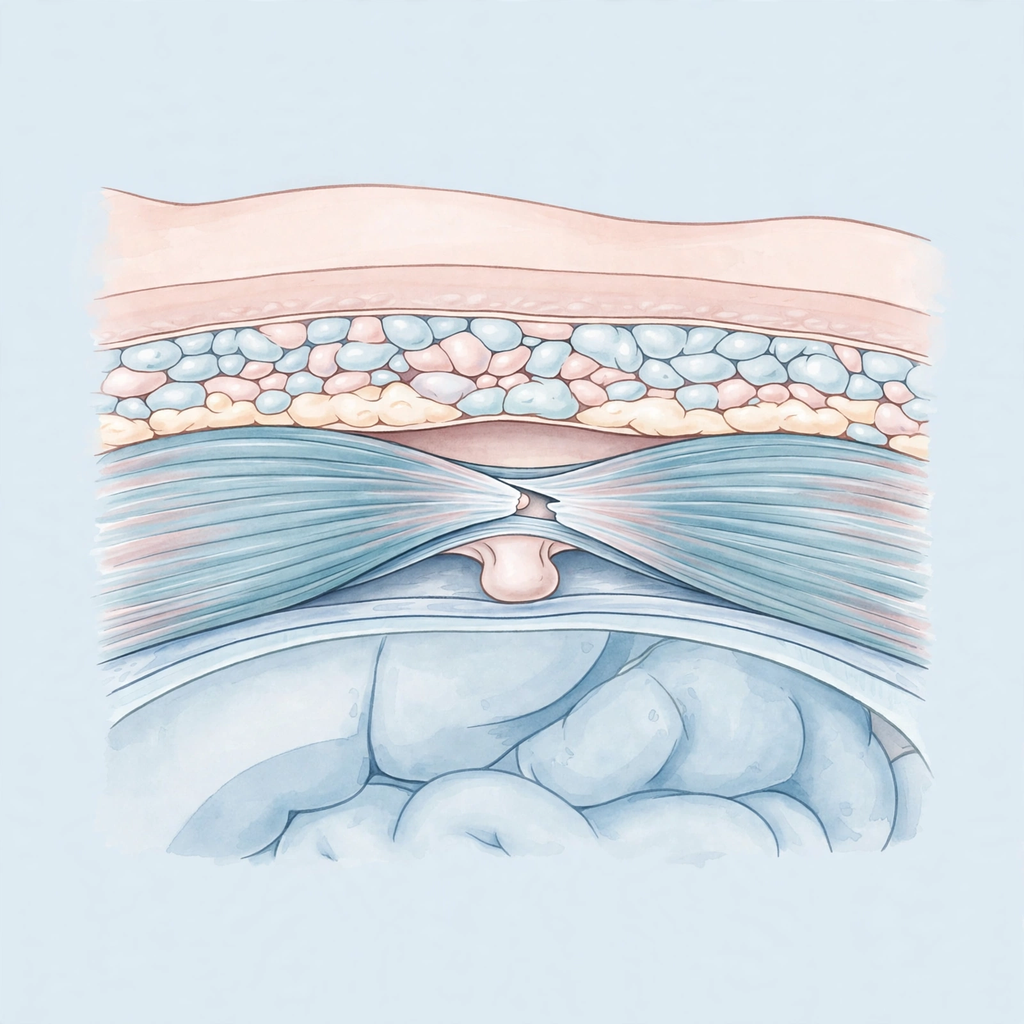
A hernia often starts quietly — a small bulge in the groin or near the navel that appears when you stand, cough or lift something heavy, and disappears when you lie down. Because it may not hurt much at first, many people postpone treatment for months or even years. Some hernias can safely be planned for repair at a convenient time, but others can become an emergency within hours. This guide explains the common types of hernia, the warning signs that mean repair should not be delayed, and the emergency symptoms that need urgent care. At Digestive Care Clinic, Kanpur, hernia patients are assessed by Dr. Himanshu Gupta, our GI and HPB surgeon, and whether you need surgery — and how soon — is decided only after specialist assessment.
What Is a Hernia?
A hernia occurs when an internal part of the body, often a loop of intestine or fatty tissue, pushes through a weak spot in the muscle or tissue wall that normally holds it in place. The weak spot may be present from birth or develop over time through strain, previous surgery, chronic cough, constipation, heavy lifting, pregnancy or increasing age. A hernia does not heal on its own. The bulge may stay the same size for a while, but the opening in the muscle wall does not close by itself, and hernias tend to enlarge slowly over time.
Support belts or trusses may make some people feel more comfortable, but they do not repair the defect. Surgery is the only way to repair a hernia, although not every hernia needs an operation immediately — the timing depends on the type, your symptoms and your overall health.
Common Types of Hernia
- Inguinal hernia: the most common type, appearing as a bulge in the groin. It is more common in men and may extend down towards the scrotum.
- Femoral hernia: a bulge just below the groin crease, more common in women. This type has a higher risk of becoming trapped, so prompt assessment is important.
- Umbilical hernia: a bulge at or near the navel. Common in children, where some close on their own, and also seen in adults, where they usually need assessment.
- Incisional hernia: a bulge through a previous surgical scar on the abdomen, where the muscle wall has weakened.
- Epigastric hernia: a small bulge in the upper abdomen, in the midline between the navel and the breastbone, often containing fat.
- Hiatal hernia: different from the others — part of the stomach pushes up through the diaphragm into the chest. It usually causes acidity and reflux rather than a visible bulge and is often managed differently.
Symptoms of a Hernia
The typical sign is a soft bulge or lump that becomes more obvious when you stand, strain, cough or lift, and may flatten when you lie down. Other common symptoms include a dull ache, heaviness or dragging sensation in the area, discomfort that worsens as the day goes on or after physical activity, and occasional sharp pain during sudden strain. Some hernias cause no pain at all and are noticed only as a swelling.
Symptoms alone do not tell the whole story. A small hernia can sometimes cause more trouble than a large one, particularly if tissue gets trapped in a narrow opening. That is why a physical examination by a specialist, sometimes supported by an ultrasound or other scan, is important before deciding on treatment.
Warning Signs That Repair Should Not Be Delayed
Book an early appointment — rather than waiting and watching — if you notice any of the following:
- The bulge is getting bigger over weeks or months.
- Pain or discomfort is increasing, or is starting to limit your work, walking or daily activities.
- The hernia no longer goes back in easily when you lie down or press it gently.
- You have a femoral hernia, or you have been told your hernia has a narrow neck, as the risk of trapping is higher.
- The skin over the bulge looks stretched, shiny or discoloured.
- You are planning for a situation that will increase abdominal pressure, and your surgeon advises repair beforehand.
For planned hernia repair in Kanpur, your surgeon will discuss whether a keyhole (laparoscopic) or open repair suits you, and whether a mesh is recommended to strengthen the repair. The choice depends on the type and size of the hernia, previous surgery, and your general health.
Emergency Warning Signs: Seek Urgent Care
Do not wait for a routine appointment if you have any of these symptoms. Seek urgent medical care immediately:
- Severe or rapidly worsening pain at the hernia site.
- A bulge that will not go back in, even when you lie down and relax — this may be an incarcerated hernia, where tissue is trapped.
- Nausea and vomiting, especially with abdominal swelling or inability to pass stool or gas, which can suggest bowel obstruction.
- Fever, or redness, tenderness and warmth over the bulge.
- A bulge that becomes hard, very tender or changes colour — this may indicate strangulation, where the blood supply to trapped tissue is cut off. This is a surgical emergency.
Do not try to force a painful bulge back in, and do not delay hoping the pain will settle. Trapped or strangulated tissue can be damaged quickly, and emergency surgery may be needed. Go to the nearest emergency service or contact your surgeon urgently.
How Is a Hernia Diagnosed?
Diagnosis is usually clinical: the specialist examines you while standing and lying down and may ask you to cough so the bulge becomes clear. An ultrasound is often used to confirm the type and size, and scans such as CT may be advised for large, recurrent or incisional hernias, or when the diagnosis is uncertain. Blood tests and an anaesthesia assessment are typically done before a planned operation.
How Hernia Repair Is Done
Hernia repair pushes the bulging tissue back and strengthens the weak area, often with a mesh. The operation can be open, through a cut over the hernia, or laparoscopic, through a few small cuts with a camera. Laparoscopic repair is commonly considered for groin hernias on both sides and for some recurrent hernias, while open repair may suit other situations. Neither approach is best for everyone; the right choice is made after specialist assessment. You can read about the wider range of operations on our surgery in Kanpur page.
Recovery depends on the type of repair and your work. Many people resume light activities gradually within a short period after planned repair, while heavy lifting is usually restricted for some weeks as advised. Mild pain, bruising and swelling near the repair are common initially and usually settle. Follow your discharge instructions, and report increasing pain, fever, discharge from the wound, vomiting or a rapidly enlarging swelling.
Frequently Asked Questions
1. Can a hernia heal on its own without surgery?
No. A hernia is an opening in the muscle wall, and it does not close by itself. Some small, symptom-free hernias can be watched safely for a time, but repair is the only definitive treatment, and the timing should be decided with your surgeon.
2. How do I know if my hernia is an emergency?
Severe pain, vomiting, fever, or a bulge that will not go back in and becomes hard, tender or discoloured are emergency signs. Seek urgent care immediately rather than waiting for a routine appointment.
3. Is mesh always used in hernia repair?
Mesh is commonly used to strengthen the repair and reduce the chance of the hernia coming back, but it is not used in every situation. Your surgeon will explain whether mesh is advised in your case and why.
4. Can a hernia come back after repair?
Yes, recurrence is possible, although repair techniques aim to keep the risk low. Following advice on lifting, weight and activity after surgery helps. If a bulge returns, get it examined rather than assuming it is harmless.
5. What is the cost of hernia repair in Kanpur?
Cost varies with the type of hernia, the repair method, mesh, hospital stay and your individual condition, so we do not quote a fixed price here. Please call the clinic for cost and assessment details.
Book an Assessment in Kanpur
If you have a bulge that is enlarging, hurting, or no longer going back in, get it examined soon — and if you have severe pain, vomiting, fever or a trapped bulge, seek urgent care straight away. For hernia repair in Kanpur, consult Dr. Himanshu Gupta (MBBS, GSVM Kanpur; DNB General Surgery; MCh GI Surgery, HPB and Liver Transplant, PGIMER Chandigarh; fellowships in laparoscopic, robotic and bariatric surgery) at Digestive Care Clinic, 174 W-2 (Doon House), Damodar Nagar, Kanpur 208027. OPD timings are Monday to Saturday, 4 PM to 8 PM. Call or WhatsApp +91-9511400141 to book an appointment. Your treatment plan will be decided only after specialist assessment.